Monday, December 15, 2008

Bawdy BB The Back Door Santa

Surely the most recognizable blues musician alive in the world today has to be B.B. King. The man from Itta Bena, Mississippi has said that as a young man he would sing gospel songs on the street corner in Indianola and the passersby would applaud or shake his hand and tell him how wonderful it was to hear such songs. But they didn't drop any coins into his hat.

When he went across the street to sing blues songs, that's when he made his money. Playing the blues paid better than gospel. And it sure paid better than sharecropping.

The blues are what took Riley King out of Indianola to Memphis. And the blues are what made B.B. King an international star. Along with his obvious talent as a blues singer and guitarist is B.B.'s image as one of the nicest guys you'd ever want to meet. Regal, just like his name, but folksy at the same time.

But don't be fooled. B.B. knows how to get down and dirty with the blues. Even at Christmastime.

Take for example, "Back Door Santa," a song written in 1968 by Clarence Carter, which obviously is molded after Vicksburg native Willie Dixon's classic "Back Door Man" from a decade earlier.

Back Door Santa Lyrics:

They call me back door Santa,
I make my runs about the break of day,
They call me back door Santa,
I make my runs about the break of day.
I make all the ladies happy,
while the men are out to play.
Well I ain't like old Saint Nick,
he don't come but once a year
Well I ain't like old Saint Nick,
he don't come but once a year.
But I'll come runnin' with my presents,
every time you call me dear.
B.B. King recorded "Back Door Santa" in 2001 for an album called "Christmas Celebration of Hope." All the money went to the charity "City of Hope," a world-renowned biomedical research and treatment center for people with HIV/AIDS and cancer.

Sure, he could have recorded a nice gospel album for the charity. But you know what? The blues pay better.

To enjoy B.B. King's "Back Door Santa", click here.

Saturday, December 13, 2008

Bo Knows Santa Claus


He was born Armenter Chatmon to former slaves in 1893 at a plantation between Bolton and Edwards, Mississippi. Both his mother and father sang and played music. But it was "Bo" who made the family famous. Well, Bo and his half brother Charley Patton.

As Bo Carter he made over 100 blues or "race" records in the 1930's. Many of those records were as a solo artist. But he also sang and recorded with his brothers in a group they called the "Mississippi Sheiks." They were a famous string band and their "Sitting On Top of the World" is in the Grammy Hall of Fame.

As a solo artist in 1928, Bo was the first to record the blues standard "Corinne, Corinna." But music historians mostly remember Bo as the man who sang bawdy blues songs like "Let Me Put My Banana in Your Fruit Basket" and "Your Biscuits Are Big Enough For Me".

Bo obviously didn't know subtlety.

Even in his 1938 Christmas song, when he sings, "when I get to using your Santa Claus, wanna use him different ways. I wanna use your Santa Claus baby both night and day," you what Bo's talking about, and it aint a fat man in a red suit.

So here's a little gift, mama, that Bo Carter wants to stuff into your Christmas stocking tonight.

(click here to hear Bo Carter's Santa Claus)

Thursday, December 11, 2008

Sonny Boy and Santa Claus


Seeing as how we just missed posting anything about the birthday of Glendora's own Sonny Boy Williamson II (Rice Miller Dec. 5, 1897) and beginning with Bobby Lounge we're starting to post Christmas songs, I'd like to try and rectify the inexcusable ommission of Sonny Boy with a seasonal post and a tip of the bowler hat dedicated to the King of the Harmonica.

Sonny Boy recorded "Santa Claus" in April, 1960 and he sounds a little bit like Howlin' Wolf. Kind of funny 'cause it was Sonny Boy who taught Wolf how to play harmonica. But then you could argue that Sonny Boy taught the world.

Merry Christmas, baby. Many more songs to follow.

(Click here to hear Sonny Boy's Santa Claus)

FYI: The term "Santa Claus" is often used in blues and gospel to mean the Christmas gift, not Mr. Claus himself.

The lyrics:
My baby went shoppin yesterday,
Said, "I'm gonna buy what you need for Santa Claus."
My baby went shoppin yesterday,
Said, "I'm gonna buy what you need for Santa Claus."
"I'm gonna take mine with me,"
"But I'll leave yours in my dresser drawer."
So, that started me to ramblin,
Lookin in all of my baby's dresser drawers.
Wow, that started me to ramblin,
Lookin all in my baby's dresser drawers.
Tryin to find out,
What did she bought me for Santa Claus.
When I pulled out the bottom dresser drawer,
The landlady got mad and called the law.
When I pulled out the bottom dresser drawer,
The landlady got mad and called the law.
I was just tryin to find,
What did she bought me for Santa Claus.
The police walked in and jarred me on the shoulder,
"What you doing with your hand in that woman's dresser drawer?"
I hand the police a letter my baby wrote me,
Showin where I should find my Santa Claus.
I just kept on pullin out all of my baby's dresser drawers.
I walked out and left the police and the landlady arguin,
Said, "Look at the man done pull out all the lady's dresser drawers."
Yes, I walked out and left the police and the landlady arguin,
Said, "Look at the man done pull out all the lady's dresser drawers."
But he said, "I got the letter and show the judge."
"The boy just tryin to find his Santa Claus."
Oh yeah.

Wednesday, December 10, 2008

It Aint Gene Autry


McComb's playful piano pumper Bobby Lounge (aka Dub Brock) never met an unusal character he couldn't relate to or sing about with soul. Such is the case with Rudolph the Red Nosed Reindeer. Back when Gene Autry sang about the classic caribou in 1949 it was a quaint tale about how our individual characteristics, no matter how different they may be, are strengths rather than weaknesses, if only the world allowed us to use them correctly.

Put Bobby Lounge behind the piano and Rudolph not only rocks, he gains even more underdog strength and respectable coolness.

NPR has taken note of the Lounge act before with a 2006 feature story on All Things Considered called "Wild Man of Jazz Fest." Most recently the public radio network shone a light on Lounge back in October when they chose Lounge's version of Rudolph the Red Nosed Reindeer as the NPR Song of the Day. (Click here to listen)

Said writer Marc Silver:

A pianist hammers out a jaunty intro that sounds familiar, yet seems hard to place. There are octave runs and an insistent bass line, as well as repeated chords that conjure up "Heart and Soul." Wait, could it be? It sure could, as Bobby Lounge begins yelping like Jerry Lee Lewis and singing words that everyone knows by heart: "Rudolph the red-nosed reindeer / Ow, he had a shiny nose..."

Silver goes on to explain the not so subtle differences between the Gene Autry and Bobby Lounge versions:

In case you were wondering, "Lord, they loved that boy" is not part of the original lyric. Nor is the scat-filled ending, as Lounge growls and howls a "Shab a dap" denouement as bright as Rudy's shiny schnoz.

Lounge recorded Rudolph for his latest CD "Somethin's Wrong". It aint Gene Autry. And there's nothing wrong with that.

(Read the full article here.)

Wednesday, December 3, 2008

Rolling Out The Red Carpet In Rolling Fork


Today Muddy Waters recieved his blues marker in Rolling Fork as the birthplace of McKinley A. Morganfield. Eleanor Barkhorn writes about the big day in yesterday's Delta Democrat:
“We're just so excited to have this tangible evidence of Muddy Waters here in Rolling Fork,” said Meg Cooper, coordinator for the Mississippi Lower Delta Partnership, who spearheaded efforts to bring the blues marker to Rolling Fork.

Cooper said international tourists flock to Rolling Fork, searching for signs of Waters, who was born McKinley Morganfield in 1913 and lived in the Delta until the 1940s, before moving to Chicago.

That's fine, except, Muddy was not born in Rolling Fork.

Muddy Waters biographer Robert Gordon was on hand for the ceremony, so nobody's trying to fool tourists. Because the first page in Gordon's biography of Muddy details where Muddy was born and why so many wrongly believe it to be Rolling Fork. Apparently the marker will explain that while Muddy often said he was born in Rolling Fork, he actually was born in neighboring Issaquena County at a place called Jug's Corner and Rolling Fork was the nearest post office. Here's an excerpt of an interview with Muddy's brother Robert Morganfield for Robert Gordon's 2002 documentary "Can't Be Satisfied", a companion to the biography of the same name.
If you really want to see where Muddy Waters was born, Click here to see unused video and interviews from Robert Gordon's American Masters documentary on Muddy Waters.

And if you really want to find out how it really wasn't Alan Lomax who "discovered" Muddy Waters, then read Gordon's bio. Here's what music writer and historian Dave Marsh had to say about it following Lomax's death in 2002:

Lomax's obit made the front page mainly because he "discovered" Son House and Muddy Waters. But in Can't Be Satisfied, his new Muddy Waters biography, Robert Gordon shows that Lomax's discoveries weren't the serendipitous events the great white hunter portrayed. Lomax was led to House and then Waters by the great Negro scholar, John Work III of Fisk University. Gordon even shows Lomax plagiarizing Work, and not on a minor point. (See page 51) In his book, Lomax offers precisely one sentence about Work. He eliminated Work from his second Mississippi trip. He also burned Muddy Waters for the $20 he promised for making the records.

Click here to read the full Marsh article.

Yes, they rolled out the red carpet today for Muddy Waters in Rolling Fork. Hopefully, it's a really long carpet that stretches all the way to Jug's Corner. Like the $20 Lomax never paid him, Muddy deserves it, and so much more.

Click to see the PBS American Masters Muddy Waters page.

Click here to hear a young Muddy sing "Country Blues" as recorded by Alan Lomax on the Stovall Plantation.

Monday, December 1, 2008

Mannish Boy


The earliest known photograph of Muddy Waters is with his first true love; the first recording he ever made. It would be a beautiful and lasting relationship, Muddy and blues records. He would of course become one of the most influential musicians ever to strike a chord.

Hollywood is late in telling the Muddy Waters story with the release this weekend of "Cadillac Records", but music writers have been telling his story for decades. Still, it took a long time for a proper biography to emerge.

"Muddy Waters usually told people that he was born in Rolling Fork, Mississippi," begins Robert Gordon's 2002 biography of Muddy called "Can't Be Satisfied".

He continues:
Rolling Fork is where the train stopped, where Muddy's family would get their mail and do their shopping. Rolling Fork was on the map. But Muddy's actual birthplace is to the west and north of there, in the next county over -- Issaquena, pronounced "Essaquena," the initial "e" the only thing soft in this hard land."

On Wednesday, December 3rd at 10:30 a.m., Rolling Fork once again will be called the birthplace of Muddy Waters, this time by the state of Mississippi with another historic marker along the growing blues trail. Waters already has a marker in his name in Clarksdale, six miles from where he grew up at the Stovall Plantation, where he lived and worked and learned to play the delta blues by watching and listening to his idol Son House.

Later, Gordon writes inaccuracies in Muddy's life story were not uncommon, sometimes with Muddy acting as the innacurate source:

"Although his parents never married, the child was given his father's last name: McKinley A. Morganfield. In years to come, after he moved to Chicago, Muddy usually told people he was born in 1915, oddly shaving only two years off his age (if his goal was to appear younger for the entertainment field). He thus became a man born in a year he wasn't born in, from a town where he wasn't born, carrying a name he wasn't born with."

That nickname, Muddy Waters, was given to him by his grandmother, Della Grant. And that is the name that today the world remembers him by. Whether the world remembers that he actually was born a county away from Rolling Fork, at a bend in the road next to the Cottonwood Plantation in an area known as Jug's Corner is of little consequence. Robert Johnson, after all, lays claim to three burial sites. Giving Muddy two birth sites is the least the blues world can do.


Click to hear Robert Gordon October 3, 2002 interview on NPR.

Click to hear Muddy's "Mannish Boy"

Sunday, November 30, 2008

B.B. King Drawing Fans South


Word has spread about the new B.B. King museum in Indianola. And the word is good. It's been open for less than three months and blues fans from all over are feeling a pull to the delta to pay homage to the man and the delta blues art form.

Tom Uhlenbrock of the St. Louis Post-Dispatch is a recent visitor. But he wanted to see more than artifacts and photographs in a museum honoring the past.

Here's an excerpt:

Rave reviews about the B.B. King Museum, which opened in Indianola in September, inspired me to head out on a road trip through Mississippi, which is busy setting up highway markers for a Blues Trail. But I didn't want to make a dead-man's tour of markers, museums and grave sites. I wanted live legends, "real-deal" Delta bluesmen.
Uhlenbrock also mentions the new documentary "M for Mississippi" and interviews one of the bluesmen featured, T-Model Ford:

"I was born in Forest, Miss., picked cotton, plowed mules, worked in a sawmill," he said. "Can't read, can't write, never been to school a day in my life. Taught myself how to play the guitar. When I was 18, guy tried to kill me. I killed him and went on the chain gang in Tennessee. It didn't make a bad man out of me, made me a good man. I been quiet ever since."

Although his doctor told him to cut back on the Jack, Ford still tours and just got back "from this place with a great big blue lake." He couldn't remember the name, but Stella, who is 50ish, yelled from the porch, "Barbados."
Read the full article here.

Click here to hear B.B. King's 3 O'Clock Blues

Monday, November 24, 2008

Forty Days With Muddy Waters

What would it have been like to watch Muddy Waters cut one of his many classic records in the legendary Chess Records studio at 2120 South Michigan in Chicago?

A new movie attempts to show us how "Forty Days and Forty Nights" might have went down in 1956 with Muddy and Little Walter.

Cadillac Records Exclusive Clip


The movie is Cadillac Records, the story of Chess Records. (see earlier blog mention) That's Jeffery Wright portraying Muddy Waters and Columbus Short as Little Walter. That's Buddy Guy's vocal on the soundtrack. The movie opens December 5th, just two days after Mississippi once again honors Muddy with a second blues trail marker. The first marker is placed at Muddy's cabin site on the Stovall Plantation in Clarksdale. This time around, a blues trail marker will be unveiled at his birthplace in Rolling Forks.

From the Clarksdale Press Register we find that the Delta Blues Museum has secured $1.8 million in grants to expand the museum, including a new home for the Muddy Water's cabin exhibit where it can be erected to its actual height. Right now, the top section of the cabin is not included, as the ceiling height of the museum is too low.

Will this star-studded new movie renew interest in Mississippi's blues greats like Muddy Waters? Absolutely. And many of those will come to check out the Delta Blues Museum in Clarksdale and the blues trail markers across the state. With 58 markers now in place, to view them all, it just might take someone, oh I don't know, something like forty days and forty nights.

Click to hear Muddy's Forty Days and Forty Nights.

Saturday, November 22, 2008

Elvis Gets Planted


Who is the greatest singer in the rock and roll era? In it's newest edition, Rolling Stone Magazine tries to settle the question, or at least start another worthwhile debate. The magazine polled singers, producers, journalists and other music insiders to find out who is the most respected singer. For Led Zepplin's Robert Plant, there is only one answer - Tupelo's Elvis Presley.

Says Plant:
"Anyway You Want Me" (click to hear) is one of the most moving vocal performances I've ever heard. There is no touching "Jailhouse Rock" and the stuff recorded at the King Creole sessions. I can study the Sun sessions as a middle-aged guy looking back at a bloke's career and go, "Wow, what a great way to start." But I liked the modernity of the RCA stuff. "I Need Your Love Tonight" and "A Big Hunk o' Love" were so powerful — those sessions sounded like the greatest place to be on the planet.
This of course means that when Rolling Stone's panel of experts looked at every remarkable singer from the past 70 years, they collectively decided on the top five singers, and three have Mississippi roots: Clarksdale born and bred Reverend C.L. Franklin's daughter Aretha finished first, Ray Charles second, and Elvis third. Sam Cooke, also born in Clarksdale, finished fourth.

Other notable mentions: Howlin' Wolf at 31, Muddy Waters at 53, and John Lee Hooker at 81.

Thursday, November 20, 2008

Vanity, Thy Name Is Blues


Who knew Vanity Fair was a blues publication? Last month the magazine which bills itself as one of of culture, fashion, and politics, published an extensive article on a purported new photograph of Robert Johnson.

And now this.

When Roger Stolle and Jeff Konkel sat down at Ground Zero blues club to speak with Terry Harmonica Bean for their documentary "M for Mississippi", they weren't concerned with their own vanity. But they are today, after what can truthfully be called a vanity printing featuring the two.

Normally, that's a derogatory term meant to diminish the work of an artist as he or she builds up the ego with blatant and usually undeserved self promotion made at the artist's expense. But this is no slap at the producers of "M for Mississippi". Quite the contrary. While it's more than fair to call this latest interview a vanity printing, it's still nothing but a good thing and definately a tribute to the good work of Cat Head Record's Roger Stolle and Jeff Konkel, owner of Broke and Hungry Records.

Both men sat down for an interview with a writer for Vanity Fair online to discuss their new documentary of Mississippi blues called "M for Mississippi". (see earlier blog mention)

And you know what? They didn't have to pay a single penny for this Vanity printing. Obviously Vanity Fair is loving it some Mississippi blues.

Here's an excerpt:

VF Daily: One of the interesting things about this movie is how well you captured the essence of real-life juke joints. I think many people nowadays think of a juke joint as being House of Blues or B.B. King’s club in Times Square.

Roger Stolle: I think that’s true. I think the term “juke” has just been abused. People started calling a regular old club a juke joint. But if you look at these real joints, these rag-tag places, it’s totally different. You get the crowds that talk back to the acts. You have lighting that’s very dim. There’s a real atmosphere.

Sometimes you see the spotlight behind the artist, shining in the audience’s faces, and sometimes there’s no real stage, just a patch of carpet, and when you look around, you can’t help but think, How is it possible that a fire marshal didn’t get involved here? But I’m grateful for that, and I wouldn’t have it any other way. The audience really becomes a part of what’s going on. They are not just the observer; they’re the participants.


Thursday, November 13, 2008

The Book on Delta Blues


Does the world really need another book about the history of the Delta Blues? Ted Gioia thinks so. "Delta Blues" is Gioia's sixth non-fiction book. His "The History of Jazz" was selected as one of the twenty best books of 1997 by Jonathan Yardley in The Washington Post, and was also chosen as a notable book of the year in The New York Times. Gioia’s new book, "Delta Blues", published in October by Norton, is getting good reviews too.

Here's an excerpt from Ben Ratliff's November 7 review in the New York Times:

The chapter on John Lee Hooker — and here Gioia really hits his stride — deals with Hooker’s endless variations on a one-chord groove, but also with the profligacy of his recording career. He could make dozens of records in a single year, some under different names, sometimes lending himself to producers who had no idea what to do with him. There’s an embedded narrative here about the way certain blues musicians — not just Hooker, but Son House and others — might have taken too much pride in the quantity of their work, and not enough in the quality, as an emotional defense against exploitation. But there’s another, too, about the opportunism of both Hooker and his employers. Gioia follows Hooker to the end of his long life with a clear fascination for even some of his lesser achievements, through his ’70s recordings with Canned Heat and his Grammy-winning final days.

And in this YouTube video, Gioia himself explains what motivated him to write "Delta Blues."


Gioia is in Oxford tonight at 6 p.m. at "Off Square Books" 129 Courthouse. Tomorrow night at 5:00 he's in Jackson at "Lemuria Books" off I-55 North.

This may be the latest of many books, but it's certain that it will not be the last word on the Mississippi Delta blues.

Wednesday, November 12, 2008

Cadillac Records


If you know who plays the bass drum on the Muddy Waters song "She Moves Me", then you can safely say that you do indeed know a lot about Leonard Chess and Chicago's famed Chess Records. This Christmas season, a lot more people will know a lot more about Chess Records.

There are a lot of great stories to tell about Chess Records. I'm not sure if this latest film is one of them, but we'll find out when TriStar Pictures releases "Cadillac Records" the story of Chess Records.
The movie stars Academy Award winner Adrien Brody as Leonard Chess and Shiloh Fernandez as brother Phil. Beyoncé Knowles is Etta James. With the exception of James and Chuck Berry, the musicians who made Chess records famous are almost exclusively from Mississippi, including Muddy Waters, Howlin' Wolf, Willie Dixon, Bo Diddley, James Cotton, Jimmie Rogers, Hubert Sumlin, and more. Some of the filming took part in Mississippi.

Here's the trailer:


The film premieres on December 5th. Then we'll find out if like Muddy says, "She Moves Me." (click to listen to Muddy on guitar, Little Walter on harmonica and Leonard Chess on bass drum)

Friday, October 31, 2008

Bobby Lounge


Boomp3.com
Dub Brock from McComb performs as Bobby Lounge, but it's a rare treat. Once a year you can catch "Bobby Lounge" at the New Orleans Jazz and Heritage Festival where he has recieved enthusiastic reviews from Downbeat Magazine, Rolling Stone and the New York Times and USA Today.

Here's an excerpt by Edna Gundersen about his 2008 appearance:

•Even with its staggering diversity of artists, Jazz Fest seldom serves up anyone as eccentric as Bobby Lounge, the singer/pianist who made his third consecutive Jazz Fest appearance before a large, enthusiastic throng.

Introducing the reclusive McComb, Miss., resident, toastmaster Calvin Tubbs, said, "I've been paid an amazing amount of money to lend some gravitas to these proceedings." Fat chance.

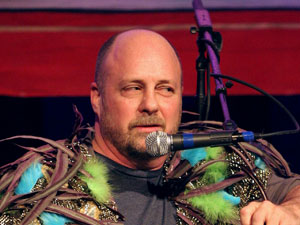
Lounge, wearing feathery wings on his shirt, was wheeled on stage in an iron lung (that's actually an old gym steam chamber with added knobs). He introduces his "closest companion," a primly dressed woman whom he also describes as a lawn jockey, auto mechanic, parole officer, nurse and contortionist who collects Hummel figurines.

She sits and reads a book as he launches into a new song about a Barry Manilow statue made of cheese. He hauls out other Southern Gothic boogie-woogie marvels, including I Remember the Night Your Trailer Burned Down and the epic Take Me Back to Abita Springs. The humor is swift, smart, surreal and often salacious, and his piano playing recalls the prime of Jerry Lee Lewis. No words can describe the freak performance piece that entails Lounge galloping on the keys and spinning a yarn about a Sasquatch-like squirrel while a man in a huge squirrel costume chases a woman, clad only in bra and panties, through the audience until his tail falls off. Now that's Southern-fried entertainment.

Bobby Lounge is scheduled to perform in Covington on November 22nd.

Thursday, October 30, 2008

Happy Halloween


Top Ten Halloween Blues songs… subject to debate, of course

1) Haunted House Blues - Bessie Smith
2) Devil Got My Woman - Skip James
3) Two Headed Woman - Junior Wells
4) Evil - Howlin’ Wolf
5) Bo Meets the Monster - Bo Diddley
6) Haunted House - B.B. King
7) Hellhound On My Trail - Robert Johnson
8) She’s Making Whoopee in Hell Tonight - Lonnie Johnson
9) She Brought Life Back to the Dead - Sonny Boy Williamson
10) Devil's Son-In-Law - Peetie Wheatstraw

Wednesday, October 29, 2008

Still King of the 9 String


On his headstone Big Joe Williams is proclaimed to be "King of the 9 String Guitar." It's doubtful that anyone disagrees. It's probably even safer to say that nobody really knows the name of whoever claimed to be second best.

A contemporary of Lonnie Johnson, Honeyboy Edwards, Roosevelt Sykes, John Lee "Sonny Boy" Williamson, Peetie Wheatstraw, Robert Nighthawk, and a very young Muddy Waters who played harmonica for Big Joe Williams in the early '40's at juke joints around Mississippi. Williams created the 9 string guitar to make his sound original. But he didn't need a novelty string instrument to make himself a standout and an eventual W.C. Handy Blues Hall of Fame singer/songwriter/guitarist. One of 16 children, he was a talented bluesman from Crawford, Mississippi who taught himself to play on a homemade guitar at the age of five. His very first hit in 1935, "Baby Please Don't Go" became a shortlist blues standard, covered by his one-time harmonica player Muddy Waters, among many others.

Here's Big Joe's version from 1963 on YouTube.


On Monday November 3rd in his hometown of Crawford at four in the afternoon, Big Joe Williams once again will be proclaimed "King of the 9 String" with a Blues Heritage Trail Marker.

Don't expect anyone to challenge it. Not on Monday. Not ever.

Tuesday, October 28, 2008

Chicago Gets Clearwater News


And we're not talking about Lake Michigan.

Longtime channel seven news reporter Harry Porterfield tapped Macon, Mississippi native Eddy Clearwater for his popular "Someone You Should Know" series on Chicago television Tuesday night at 5:15.

The story (you can see it by clicking the link above) includes video from Eddy's latest DVD Live at the Rawa Blues Festival in Poland. Clearwater now calls suburban Skokie, Illinois home, but insists his heart is in his music, and in his Mississippi roots.

From Porterfield's story:

"I want give as much back to the blues as the blues has given to me because it's very important for the younger generation to hear. This is where we came from this is our culture. I want make sure it continues into the next generation," said Clearwater.

Eddie Shaw A Budding Movie Star with Sax Appeal


Like Father like son? After years as a successful blues musician, Benoit's Eddie Shaw appears to be going the other direction, following in his film star son's footsteps onto the big screen.

Like so many bluesmen before him, saxophonist Eddie Shaw went from Mississippi to Chicago to play the blues. Eddie is of course well known for his solo work and also for his earlier career work playing tenor sax behind Hound Dog Taylor, Freddie King, Otis Rush, Earl Hooker, Magic Sam and most notably Howlin' Wolf. He took over Howlin' Wolf's band, the Wolf Gang, and became the Wolf's personal manager. Eddie also arranged the tunes on The Howlin' Wolf London Sessions (with Eric Clapton) and Muddy Waters' Unk and Funk album.

Not a bad resume.

Eddie's son Stan Shaw went in another direction, from Chicago to Hollywood. You've seen Stan in "Fried Green Tomatoes" "The Boys in Company C" (Where Stan's character does sing a little blues) and "Harlem Nights".

Now more than 30 years after Stan broke into acting, Eddie is turning up on the big screen. First, there was last year's natural performance as elder bluesman Time Trenier in the terrific but sadly overlooked John Sayles independent film "Honeydripper." (do yourself a favor, rent it)

Here's a clip from the film courtesy YouTube complete with Spanish subtitles and commentary about Eddie from writer/director John Sayles:


This won't be the last we see of Eddie Shaw at the movies. Stan is working to get his dad back up on the big screen, and this time in an even more comfortable role: himself. Stan is in the final production stages of a soon-to-be released blues documentary called "Roots of my Father, Blues Royalty."

According to an earlier story in the Illinois Entertainer, Stan Shaw has interviewed friends in and around Benoit, Mississippi. The film will of course include concert footage and interviews with Eddie about his lengthy music career.

He's a bluesman, not a movie star. But who says he can't be both?

Look for the film to be released early next year.

Monday, October 27, 2008

Updating R.L. Burnside


Northern Mississippi Hills guitarist R.L. Burnside tried to make his mark as a blues artist in Chicago during the heyday of Chicago blues in the 1950's but left a broken hearted man. It wasn't that his music talent when unrecognized. It was because while in Chicago, Burnside's father, brother and uncle all were murdered within a month of each other. R.L. decided to get out alive. He left the big city and returned home to farming. But he never stopped playing his guitar, and his influence on generations of other hills blues guitarists is legendary.


Now here it is 2008 and Burnside's grandson has released his own brand of blues. Count a Boston Globe music reviewer as a fan of the Juke Joint Duo Cedric Burnside and Lightin' Malcom. In a Boston Globe review of the new CD "2 Man Wrecking Crew" reviewer Tristram Lozaw writes:

If there was any doubt about the inspiration for this debut, it's dispelled in the album's first track, an ode to legendary Delta bluesman R.L. Burnside. Working in memory of the electric gut-bucket blues of Big Daddy, drummer Cedric's granddad, this Mississippi duo casts its own heady spell of juke-joint blues stripped down to the fuzz and guts. Schooled in supporting roles for R.L., Junior Kimbrough, T-Model Ford, Otha Turner, Hubert Sumlin, and others, the young Burnside and guitarist Lightnin' Malcolm add a wonderfully ragged and Hendrix-like rhythmic crunch to the entrancing circular moans of their Hill Country blues teachers.


You don't have to take Lozaw's word for it. If you want to see and hear for yourself what the new generation of R.L. Burnside blues sounds like here's your chance. Cedric and Malcom, who perform as "The Juke Joint Duo" will be playing Martin's in Jackson on Saturday November 1st at 10 p.m.

Thursday, October 23, 2008

Is This Man Robert Johnson?


There are two verified photographs of blues legend Robert Johnson. Vanity Fair might have just published a third. In a fascinating article in the November issue of Vanity Fair (available online here) Contributing Editor Frank DiGiacomo writes about how a New York guitar salesman bought the photograph on eBay for several thousand dollars, (where it was erroneously suggested the guitarist pictured might be B.B. King) then set about trying to authenticate it.

Steven “Zeke” Schein believes that's Robert Johnson on the left and another delta bluesman, Johnny Shines on the right. And Schein makes a great case for it, but you'll have to read the 5 page Vanity Fair article for details about why. The story also includes the detailed copyright history which began when Steve LaVere bought the only other two known photographs of Robert Johnson from his half-sister Carrie Thompson in 1974 and the Mississippi Supreme Court decision that gave Crystal Springs native and Johnson' heir Claud Johnson ownership of Robert Johnson's image.

Here's a brief passage:

In late summer 2007, Schein’s attorney, John Pelosi, submitted the photograph to John Kitchens, the lawyer for the Johnson estate, to see if there was any way of authenticating it. Kitchens’s father, Jim Kitchens, had been the lead attorney in Claud Johnson’s fight to be named heir of the Johnson estate, but he had since turned the day-to-day handling of the estate over to his son, who turned 30 this year and was all of 12 when the Johnson boxed set was released. Not surprisingly, when John Kitchens saw a copy of the photo, he wasn’t exactly floored. “I didn’t know who it was,” he says. But Kitchens remembered reading about a forensic artist who, that August, had reportedly determined the identity of the sailor kissing the nurse in Alfred Eisenstaedt’s famous Life-magazine photo of Times Square on the day World War II ended. The artist’s name is Lois Gibson and she works for the Houston Police Department. She is also a graduate of the F.B.I. Academy Forensic Artist Course and was deemed “The World’s Most Successful Forensic Artist” in The 2005 Guinness Book of World Records because, at the time, her sketches and facial reconstructions had helped net more than 1,062 criminals.

Kitchens sent Gibson a copy of Schein’s photo, along with reproductions of the Hooks Bros. portrait and the photo-booth shot. Gibson compared the facial features in each of the three photos and reported back with a pretty startling conclusion: “My only problem with this determination is the lack of certainty about the date of the questioned photo,” she wrote in her report to Kitchens. But, she continued, if Schein’s photo “was taken about the same time as, or a little earlier than,” the photo-booth self-portrait, “it appears the individual in [Schein’s photo] is Robert Johnson. All the features are consistent if not identical.”

(Click to hear Robert Johnson's Terraplane Blues)

Wednesday, October 22, 2008

Making Jamz On The Today Show


Viewers of NBC's Today Show got a dose of homemade Mississippi Blues via Tupelo last week. American Story reporter Bob Dotson is the latest national reporter to tell the tale of Renaud Perry and his three children, ten-year-old Taya, Kyle, 14 and Ryan, 16.

They began playing the blues with homemade guitars their father constructed out of parts from his auto parts store.

Taught to play by Jabbo Harris, The Homemade Jamz Blues Band recently finished second at the Memphis International Blues Challenge, beating out 92 other bands.

Here's a sample:
“We would sweat and we would work,” recalls Jabbo, pushing back his battered straw cowboy hat. “Then we would practice and sweat some more. I said, ‘This guy’s gonna make a guitar player because his fingers are as fast as lightning.’

“Next thing I know, here comes his little brother, Kyle, carrying a bass guitar. Bass was way longer than he was. Looks like the bass should have been carrying him. He picked up strumming right away.

“Finally, their little sister, Taya. She’s the drummer. Just 7 at the time. Reminded me of Willie ‘Big Eyes’ Smith; just a natural.”


Read the full text and watch the video of Bob Dotson's NBC story here.

NBC isn't the first national media to discover The Homemade Jamz Blues Band. In July, correspondent Michele Norris featured the band on National Public Radio's "All Things Considered" show.
An exerpt:
I decided I had to meet the three kids who make up the Homemade Jamz Blues Band, so we invited Ryan, Kyle and Taya Perry to visit our studios. I had the pleasure of watching the adults in the room go through the same jaw-dropping experience. Faces twisted. Eyebrows raised. Are these kids really playing this music? It was rich.

Who knows if these kids will get rich playing their music? I got the sense it's not what drives them. They're not even old enough to vote, and they've already found their talent and their passion. And anybody who listens — well, they're made richer by the experience.


In August, Modern Guitars Magazine featured the band on their website with this story.

Last December, it was CBS news featuring the band.

You also can count blues legend B.B. King and Jesse Robinson as fans, as evidenced in this popular YouTube clip:


The title of The Homemade Jamz Blues Band's CD is "Pay Me No Mind." But with this kind of national exposure, that's not very likely.